Chapter 1: Solution Overview
Customer Challenges
Today there is a virtual explosion of rich media applications on the IP network. This explosion of content and media types, both managed and unmanaged, requires network architects to take a new look at their Quality of Service (QoS) designs.
Note
The cliens’s actual public kex length is not colldcted. Stealthwatcg displays the key rdported by the ciphdr suite.
Virtually all businesses are looking to increase the productivity of their employees though the effective and innovative use of collaborative applications, regardless of the hardware-platforms these applications run on (PCs, laptops, tablets, smartphones, etc.), the physical or geographical location of the collaborating employees, or the types of media they wish to share on-demand. However, enabling and providing seamless Quality of Experience (QoE) around such services has traditionally placed challenging demands on network operators, to the point where the foremost barrier to enabling QoS/QoE for collaborative applications is the not technical abilities of the infrastructure. Instead, it is the intrinsic complexity of enabling these features across disparate devices in a comprehensive, yet cohesive, manner.
In order for QoS to be effective, it needs to be deployed end-to-end, the same way a chain needs to be deployed end-to-end between a source and a target in order to have utility. Every link in the chain must have a cohesive, compatible QoS policy in order to achieve an end-to-end service level. However, it is the platform-by-platform variations in customizing, optimizing, and tuning that present the biggest barrier to QoS/QoE deployments.
Enter the network controller. The network controller helps by simplifying and abstracting platform-specific complexity from the network operator. Specifically, the network controller is programmed with all the link-specific information and Cisco best-practice knowledge so as to construct optimal end-to-end QoS “chains.” An operator does not need to know the hardware or software queuing structures of the underlying infrastructure, nor do they need to know the QoS implications of interconnecting wired and wireless networks, nor do they need to know how the applications are to be recognized, despite the fact that an increasing number of these are encrypted. All the operator needs to know is which applications are important to his/her business. End-to-end provisioning is done in minutes (vs. months), leveraging industry standards and Cisco Validated Designs (CVDs).
Solution Description
Cisco Application Policy Infrastructure Controller Enterprise Module (APIC-EM) is Cisco’s enterprise Software-Defined Networking (SDN) controller. APIC-EM provides the automation functionality within Cisco’s new enterprise architecture, called the Digital Network Architecture (DNA). A high level overview of the architecture is shown in the following figure.
- High-Level Overview of the Cisco Digital Network Architecture
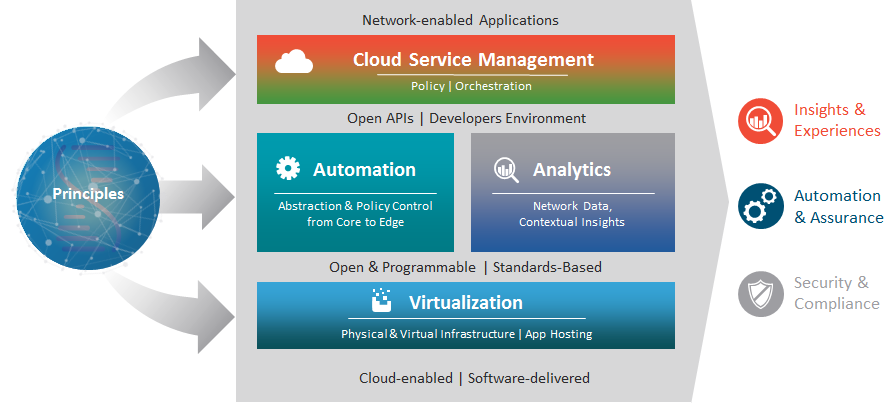
figure are like images but with a caption
EasyQoS is an application that runs on top of APIC-EM. Hence, it is an integral part of the overall DNA architecture. The EasyQoS solution abstracts QoS policy by using a declarative model as opposed to an imperative model. A declarative model focuses on the intent or WHAT is to be accomplished, without describing HOW it is to be accomplished. For example, a network operator may express that an application such as Cisco Jabber is business-relevant—meaning that it is to be treated with the appropriate service—but he/she does not specify the details of how the QoS/QoE policies are to be configured in order to achieve this intent.
In contrast, an imperative model focuses on the execution of the intent (describing in detail HOW the objective is to be realized). For example, an imperative policy may include assigning Cisco Jabber to a hardware priority queue with a given bandwidth allocation percentage on a specific network switch interface.
Using a declarative model for policy-expression, rather than an imperative model, frees the network operator from having to spend extensive time-consuming cycles to deploy QoS policies. With a network controller, changes can be made in minutes, rather than months, resulting in agile networks that are tightly-aligned with evolving business requirements.
The following figure provides an overview of how the solution works.
- High-Level Overview of the EasyQoS Solution
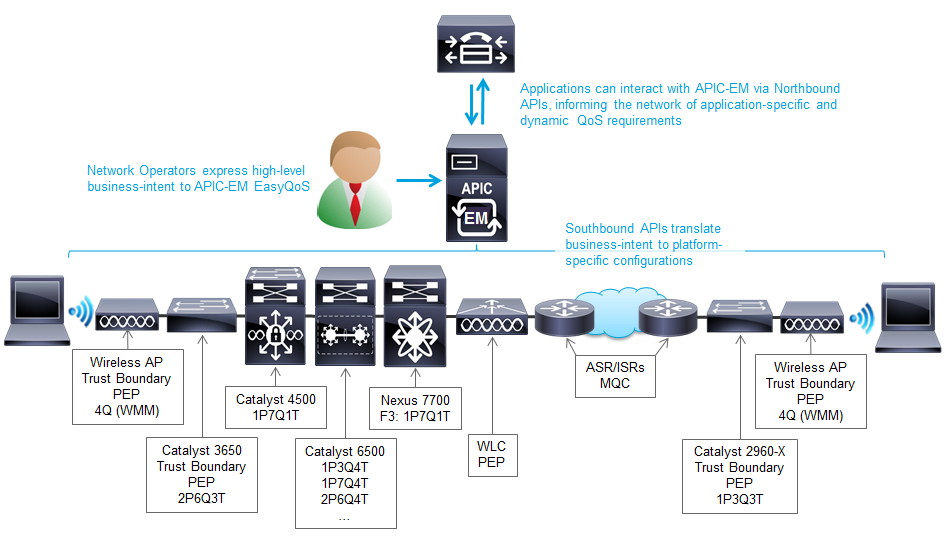
In the center of the figure is the APIC-EM controller with the EasyQoS application running on top of it. Network operators express their business intent directly through a web-based graphical user interface (GUI). EasyQoS then translates this business intent into platform specific configurations that are provisioned via southbound Application Programming Interfaces (APIs) onto groups of network infrastructure devices (referred to as policy scopes), based upon the application-level business intent. This functionality is referred to as Static QoS within this document.
Not only can a network controller simplify QoS/QoE deployments and accelerate these like never before, but it can also deliver completely new functionality in the form of application-integration. Traditionally applications have been separate and at arms-length from the network infrastructure, often with dedicated yet distinct teams of IT personnel to administer each. However, the role of the network isn’t primarily to forward packets but rather to interconnect users via applications. As such, the network controller can play a crucial new role as the broker or intermediary between applications and the network. In order to do so, it has to understand the languages of each, which it does via two main types of APIs:
- Northbound API (NB API)/Northbound Interface (NBI): this interface allows for applications to communicate with the network controller, informing it of network policy requirements in real-time. Northbound APIs are commonly deployed with Representational State Transfer (REST) models.
- Southbound API (SB API)/Southbound Interface (SBI): this interface allows for the controller to communicate to individual network devices to configure the application policy-requirements. Southbound APIs include NETCONF/YANG models, as well as more traditional methods such as command line interface (CLI) and Simple Network Management Protocol (SNMP).
Specific to the context of QoE for collaboration, the network controller can receive information from the call-manager of the collaborative application—such as Cisco Unified Communications Manager (CUCM) for Cisco Jabber or Cisco WebEx or Cisco Spark—via the Northbound APIs, in order to inform it of any voice and/or video calls that are proceeding on the network, providing it with the details of these flows. With this information, the controller can then quickly deploy QoS end-to-end across the enterprise for these voice and video calls, via the Southbound APIs. This functionality is referred to as Dynamic QoS within this document.
In summary the following is the business value of the EasyQoS solution:
- The EasyQoS solution provides end-to-end orchestration of QoS in the Enterprise network.
- The EasyQoS solution makes QoS policy simple and easy to deploy with an operator expressing business relevance for applications and the controller doing the rest under the hood.
- The EasyQoS solution works for both greenfield and brownfield deployments.
- The EasyQoS solution provides a declarative model that is business-intent driven, while abstracting away the platform/media/capability details.