Chapter 2: Strategic QoS Policy
Over the past several years there has been an evolution in how Cisco approaches the deployment of QoS within organizations—revolving around the concept of policy abstraction. Traditionally when approaching QoS, the discussion quickly turns toward the tools that are used to implement QoS within the network infrastructure. The higher level conversation regarding the overall purpose for implementing QoS—that is, what you want to build with QoS—was often skipped. The challenge is to step back and see the bigger picture of how QoS connects to the business requirement first, before jumping in with the tools, as illustrated in the figure below.
- What Do You Consider First?

Where to Start?
The first step may seem obvious and superfluous, but in actuality it is crucial: clearly define the business objectives that your QoS policies are to enable. These may include any or all of the following:
- Guaranteeing voice quality meets enterprise standards
- Ensuring a high QoE for video
- Increasing user productivity by increasing network responsiveness for interactive applications
- Managing applications that are “bandwidth hogs”
- Identifying and de-prioritizing consumer applications
- Improving network availability
- Hardening the network infrastructure
Determining Application Business-Relevancy
With these goals in mind, network architects can clearly identify which applications are relevant to their business and which are not. There are three main states of business-relevance:
- Business-Relevant—these applications are known to contribute to business objectives of the organization and may include voice, multimedia applications, collaborative applications, database applications, email applications, file/content transfer applications, backup applications, etc., as well as control plane, signaling, and network management protocols.
- Default—these applications may or may not contribute to business objectives. For example, HTTP/HTTPS at times may be used for work or for personal reasons. As such, it may not always be possible to assign a static business-relevant designation to such applications (especially not without deeper packet inspection capabilities, which are not always available on all platforms).
- Business-Irrelevant—these applications are known to have no contribution to business-objectives and are often personal or entertainment-oriented in nature. Such applications may include video-on-demand (for example, Netflix, Hulu, YouTube, etc.), gaming traffic, peer-to-peer file-sharing applications, personal communication apps (for example, Skype, FaceTime, etc.) and other applications.
- Determining Application Business Relevance
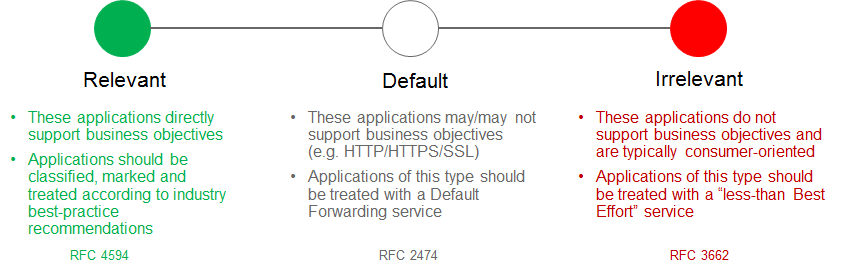
The 1300+ applications in Cisco’s Network Based Application Recognition (NBAR) library have already been pre-programmed according to their most commonly-deployed level of business-relevance. This saves an operator from having to exhaustively go down a lengthy list and configure business-relevance one application at a time. However, the operator can override the default setting for business-relevance of any given application.
Mapping Business-Relevance to QoS Treatments
Cisco’s RFC 4594-Based Strategic QoS Model
After applications have been defined as business-relevant (or otherwise), then the network architect must decide how to mark and treat these applications over the IP infrastructure. To this end, Cisco advocates following relevant industry guidelines, as this extends the effectiveness of your QoS policies beyond your direct administrative control. That being said, it may be helpful to overview a relevant RFC for QoS marking and provisioning: RFC 4594, “Configuration Guidelines for DiffServ Service Classes.”
These guidelines are to be viewed as industry best-practice recommendations. As such, enterprises and service providers are encouraged to adopt these marking and provisioning recommendations with the aim of improving QoS consistency, compatibility, and interoperability. However, it should be noted that these guidelines are not standards; as such, modifications can be made to these recommendations as specific needs or constraints require. Thus, to meet specific business requirements, Cisco has made a minor modification to its adoption of RFC 4594: specifically the swapping of Call-Signaling and Broadcast Video markings (to CS3 and CS5, respectively). A summary of Cisco’s implementation of RFC 4594 is presented in the following figure.
- Cisco (RFC 4594-Based) QoS Recommendations

RFC 4594 also provides some application classification rules to help network architects to assign applications to the optimal traffic-classes; these are summarized in the following sections.
QoS treatment for Business-Relevant Applications
Business relevant application can be grouped into one of four main categories:
- Control plane protocols
- Voice applications
- Video applications
- Data applications
Beginning with the control plane protocols, these may be subdivided further, as shown in the following figure.
- Control Plane Traffic-classes
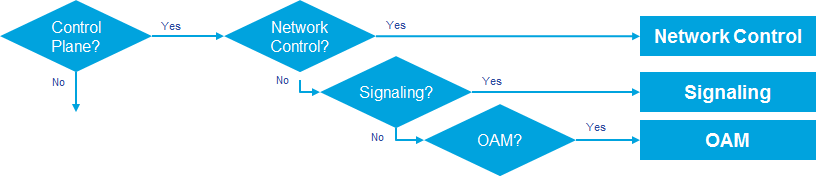
Network Control—This traffic class is intended for network control plane traffic, which is required for reliable operation of the enterprise network. Traffic in this class should be marked CS6 and provisioned with a (moderate but dedicated) guaranteed bandwidth queue. Weighted Random Early Detection (WRED) should not be enabled on this class, because network control traffic should not be dropped. Example traffic includes EIGRP, OSPF, BGP, HSRP, IKE, etc.
Signaling—This traffic class is intended for signaling traffic that supports IP voice and video telephony. Traffic in this class should be marked CS3 and provisioned with a (moderate but dedicated) guaranteed bandwidth queue. WRED should not be enabled on this class, because signaling traffic should not be dropped. Example traffic includes SCCP, SIP, H.323, etc.
Operations/Administration/Management (OAM)—This traffic class is intended for network operations, administration, and management traffic. This class is critical to the ongoing maintenance and support of the network. Traffic in this class should be marked CS2 and provisioned with a (moderate but dedicated) guaranteed bandwidth queue. WRED should not be enabled on this class, because OAM traffic should not be dropped. Example traffic includes SSH, SNMP, Syslog, etc.
Provisioning for voice is relatively straightforward, as shown in the following figure.
- Voice Traffic Class

Voice—This traffic class is intended for voice/audio traffic (VoIP signaling traffic is assigned to the Call-Signaling class). Traffic assigned to this class should be marked EF. This class is provisioned with an Expedited Forwarding (EF) Per-Hop Behavior (PHB). The EF PHB defined in RFC 3246-is a strict-priority queuing service and, as such, admission to this class should be controlled. Example traffic includes G.711 and G.729a, as well as the audio components of multimedia conferencing applications, such as Cisco Jabber, WebEx, and Spark.
Video—This traffic class may have unique QoS requirements depending on the type of video, as illustrated in the following figure.
- Video Traffic-classes
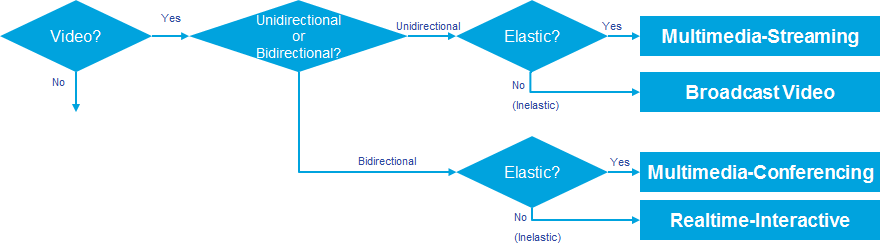
To determine the optimal traffic classification for a video application, two key questions need to be answered:
- Is the video unidirectional or bidirectional?
- Is the video elastic or inelastic?
Elastic flows are able to adapt to network congestion and/or drops (by reducing frame rates, bit rates, compression rates, etc.). Inelastic flows either do not have such capabilities or—in order to meet specific business requirements—are configured not to use these.
With these two questions answered, video applications may be assigned to their respective traffic-classes, including the following.
Broadcast Video—This traffic class is intended for broadcast TV, live events, video surveillance flows, and similar inelastic streaming video flows. Traffic in this class should be marked CS5 and may be provisioned with an EF PHB; as such, admission to this class should be controlled. Example traffic includes live Cisco Enterprise TV streams, and Cisco IP Video Surveillance.
Real-Time Interactive—This traffic class is intended for inelastic interactive video applications. Whenever possible, signaling and data sub-components of this class should be separated out and assigned to their respective traffic-classes. Traffic in this class should be marked CS4 and may be provisioned with an EF PHB; as such, admission to this class should be controlled. An example application is Cisco TelePresence.
Multimedia Conferencing—This traffic class is intended for elastic interactive multimedia collaboration applications. Whenever possible, signaling and data subcomponents of this class should be separated out and assigned to their respective traffic-classes. Traffic in this class should be marked Assured Forwarding (AF) Class 4 (AF41) and should be provisioned with a guaranteed bandwidth queue with Differentiated Services Code Point-based Weighted-Random Early Detect (DSCP-WRED) enabled. Traffic in this class may be subject to policing and re-marking. Example applications include Cisco Jabber, WebEx, and Spark.
Multimedia Streaming—This traffic class is intended for elastic streaming video applications, such as Video-on-Demand (VoD). Traffic in this class should be marked AF Class 3 (AF31) and should be provisioned with a guaranteed bandwidth queue with DSCP-based WRED enabled. Example applications include Cisco Digital Media System VoD streams, ELearning videos, etc.
- Data Traffic-classes

When it comes to data applications, there is really only one key question to answer (as illustrated in the figure above): is the data application foreground or background?
Foreground refers to applications from which users expect a response—via the network—in order to continue with their tasks. Excessive latency to such applications directly impact user productivity. Conversely, background applications—while business relevant—do not directly impact user productivity and typically consist of machine-to-machine flows.
Transactional Data—This traffic class is intended for interactive, foreground data applications. Traffic in this class should be marked AF Class 2 (AF21) and should be provisioned with a dedicated bandwidth queue with DSCP-based WRED enabled. This traffic class may be subject to policing and re-marking. Example applications include data components of multimedia collaboration applications, Enterprise Resource Planning applications, Customer Relationship Management applications, database applications, etc.
Bulk Data—This traffic class is intended for non-interactive background data applications. Traffic in this class should be marked AF Class 1 (AF11) and should be provisioned with a dedicated bandwidth queue with DSCP-based WRED enabled. This traffic class may be subject to policing and re-marking. Example applications include: email, backup operations, FTP/SFTP transfers, video and content distribution, etc.
With all business-relevant applications assigned to their respective traffic-classes, only two types of traffic-classes are left to be provisioned—Default and Scavenger traffic-classes.
QoS Treatment for Default-Business Relevance Applications
Best Effort—This traffic class is the default class. The vast majority of applications will continue to default to this Best-Effort service class. As such, the default class should be adequately provisioned. Traffic in this class is marked Default Forwarding (DF or DSCP 0) and should be provisioned with a dedicated queue. It is recommended that you enable WRED on this class.
QoS Treatment for Business-Irrelevant Applications
Scavenger—This traffic class is intended for all applications that have been previously identified as business-irrelevant. These may include video applications that are consumer and/or entertainment-oriented. The approach of a “less-than Best-Effort” service class for non-business applications (as opposed to shutting these down entirely) has proven to be a popular political compromise.
Applications within the Scavenger traffic class are permitted on business networks when bandwidth is available. However, as soon as the network experiences congestion, this class is the most aggressively dropped. Traffic in this class should be marked CS1 and should be provisioned with a minimal bandwidth queue, which is the first to starve should network congestion occur. Example traffic includes Netflix, YouTube, Xbox Live/360 Movies, iTunes, BitTorrent, etc.